On November 18, the Maryland General Assembly’s Spending Affordability Committee received an updated fiscal outlook from the Department of Legislative Services (DLS), highlighting significant budget challenges over the next several years. Analysts projected structural deficits exceeding $2.5 billion beginning in fiscal 2028, with annual shortfalls surpassing $3 billion by fiscal 2030. A moderate economic recession could further widen those gaps by approximately $1 billion.
According to DLS, Maryland faces approximately $681 million in anticipated general fund deficiency appropriations for fiscal 2027, primarily attributable to provider reimbursements and prior-year costs. The fiscal 2028 structural deficit is projected at approximately $2.6 billion, with ongoing revenues expected to cover only about 91.7% of ongoing spending. Structural deficits are projected to remain above $3 billion annually from fiscal 2030 through fiscal 2032.
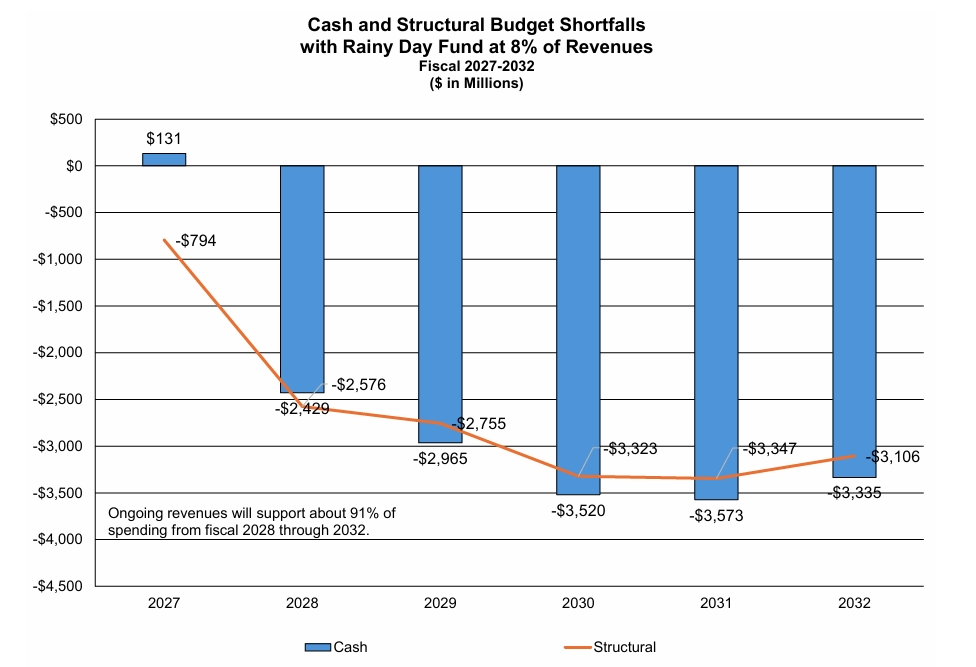
Graph courtesy of the Department of Legislative Services – November 18, 2026, Spending Affordability Briefing Materials
DLS also presented a moderate recession scenario to illustrate how an economic downturn could further strain state finances. Under the scenario, Maryland would lose approximately 79,000 jobs, with unemployment rising to 5.8% by the third quarter of 2027. The state would not fully recover those jobs until mid-2029. Reduced income, sales, and corporate tax collections, coupled with increased expenditures, could push annual structural deficits above $4 billion in fiscal 2030. Analysts emphasized that the scenario is a stress test rather than a prediction of an impending recession.
Senate President Bill Ferguson (D-Baltimore City) noted that the projected shortfall is approximately 55% greater than the deficit Maryland faced during the Great Recession, after adjusting for inflation. DLS analysts urged lawmakers to begin addressing the projected gaps before a potential economic downturn further limits the state’s fiscal flexibility.
The briefing follows a recent announcement by Governor Wes Moore, Senate President Ferguson, and House Speaker Joseline Peña-Melnyk (D-Prince George’s and Anne Arundel) that they intend to develop a four-year plan to address the state’s ongoing structural deficits. The approach would represent a departure from the state’s traditional practice of addressing budget shortfalls on an annual basis.
As lawmakers prepare for the 2027 legislative session, potential spending reductions, revenue measures, and adjustments to existing commitments are expected to remain central to budget discussions. The Board of Revenue Estimates will release updated revenue projections in December and March, which could further shape the fiscal outlook as Governor Moore prepares to submit his fiscal 2028 budget in January.
The full DLS Spending Affordability Briefing Materials are available here.