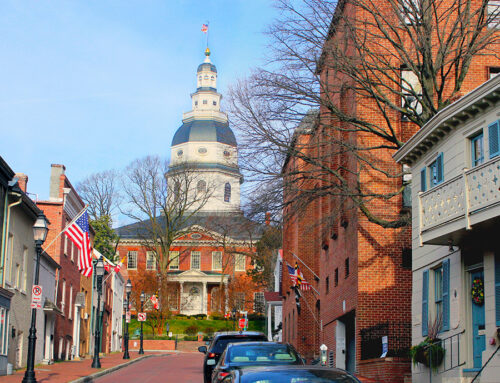
Last week, Governor Wes Moore, Senate President Bill Ferguson, and House Speaker Joseline Peña-Melnyk gathered at the State House for the final bill signing after the 2026 legislative session, signing more than 270 new laws. A number of those measures take effect today, spanning education technology, economic development, elections, professional licensing, and healthcare. Below are seven bills that take effect today and their impact:
Artificial Intelligence Ready Schools Act (SB 720)
The Artificial Intelligence Ready Schools Act directs the Maryland State Department of Education to issue statewide guidance on AI use in public schools. Once published, local school systems have 120 days to adopt their own AI policies, designate a central-office AI coordinator, and integrate AI literacy into computer science and workforce-preparation curricula.
Procurement Preferences – Reauthorization and Revisions (HB 1578)
This law extends Maryland’s Minority Business Enterprise program and related procurement preferences, requiring state agencies to consider minority-owned businesses in contracting across cannabis, offshore wind, public-private partnerships, and sports wagering. Several reporting and evaluation deadlines are also extended to preserve oversight requirements pending future legislative review.
Authority at Polling Places, Early Voting Centers, and Counting Centers – Revisions (SB 670)
This law allows the State Elections Administrator and local election directors to independently direct law enforcement inside polling environments, including ordering the removal or arrest of anyone disrupting the peace or attempting to intimidate voters. The law also updates rules governing partisan challengers and poll watchers, giving election officials greater authority to limit their access.
The DECADE Act (SB 388)
The DECADE Act, an Administration bill, broadens Maryland’s economic development toolkit by expanding state grants, loans, and tax incentives; extending several business tax credit programs; and creating new incentives for technology, research, and redevelopment projects. Certain information technology services and digital products are exempted from the state sales tax, and the renamed “Strategic Closing Fund” gains additional capacity. Agencies must now evaluate whether incentive programs are actually producing jobs and investment before they continue.
Health Occupations – Criminal History Records Checks (HB 1420)
The law establishes a uniform, mandatory criminal history check, including fingerprinting and state and federal records reviews, for a broad range of licensed health professions. Newly covered fields include acupuncture, dentistry, dietetics, environmental health, mortuary science, pharmacy, physical therapy, podiatry, and psychology, among others.
State Boards and Commissions – Sunset Extensions (HB 241)
This law prevents several Maryland licensing boards from sunsetting, extending state oversight of barbers, cosmetologists, professional land surveyors, real estate appraisers, appraisal management companies, home inspectors, and individual tax preparers through July 1, 2032. The Maryland Department of Labor must report to the General Assembly by July 1, 2030 to allow a checkpoint before the next sunset review.
Hospitals – Immigration Enforcement Action – Policy Requirement (SB 792)
The law requires all Maryland hospitals to develop a written policy governing immigration enforcement action on their premises, distribute it to staff, and provide annual training to ensure consistent implementation.